

The modern logistics industry relies on a precise division between the power used to move a vehicle and the energy used to preserve its cargo. This distinction lies at the heart of “cold chain” logistics, where temperature-sensitive goods such as food and medicine travel thousands of miles. To manage this, the industry uses two different diesel systems: tractor fuel and transport refrigeration unit (TRU or “reefer”) fuel. While both systems utilize diesel engines, they operate under different mechanical, fiscal, and environmental rules.
Understanding Tractor Diesel vs. Reefer Fuel
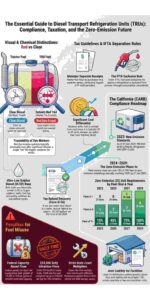
These large engines range from 20 to 300 horsepower and move up to 80,000 pounds across public highways. Because these trucks use the road system, their fuel is taxed under federal and state excise laws to fund infrastructure maintenance. To show that these taxes have been paid, tractor diesel is usually clear or has a light amber color.
In contrast, reefer fuel powers small, independent engines on specialized trailers. These engines, typically between 10 and 30 horsepower, run the compressors that keep cargo cold. Because these units do not contribute to highway wear, they are exempt from most road-use taxes. To prevent tax evasion, this fuel is dyed bright red with a synthetic substance called Solvent Red 164. This dye makes the fuel easy for inspectors to identify during checks.

| System Attribute | Tractor Propulsion System | Transport Refrigeration Unit (TRU) |
| Engine Output | 20 to 300 horsepower | 10 to 30 horsepower |
| Primary Mechanism | High-torque mechanical propulsion | Refrigerant compression and heat exchange |
| Fuel Storage Capacity | 100 to 300 gallons (dual saddle tanks) | 50 to 100 gallons (independent tank) |
| Consumption Rate | 5 to 8 Miles Per Gallon (MPG) | 0.5 to 1.5 gallons per hour |
| Fuel Appearance | Clear or straw-colored | Bright red (dyed) |
| Tax Status | Fully taxed for highway use | Tax-exempt for off-road use |
Ultra-Low Sulfur Diesel (ULSD) Standards for Reefer Units
Today, almost all of the diesel fuel sold in North America is Ultra-Low Sulfur Diesel (ULSD). This means the fuel contains no more than 15 parts per million (ppm) of sulfur. ULSD is necessary because older, high-sulfur fuel would damage the modern emissions-control hardware found on newer trucks, such as diesel particulate filters (DPFs).
However, the process to remove sulfur also reduces the fuel’s natural lubricity. To compensate for this, reefer fuel contains a stronger additive blend. These additives are crucial because reefer units start and stop often and must operate in extreme outdoor environments. Special anti-gelling agents prevent the fuel from thickening or “waxing” in cold weather, which could otherwise shut the unit down and spoil the cargo.
IFTA Reporting Rules for Reefer Fuel
The International Fuel Tax Agreement (IFTA) simplifies fuel tax reporting for carriers that operate in multiple states or provinces. Under this agreement, truckers file one quarterly report to their base jurisdiction. A critical rule for any reefer operator is that reefer fuel must stay separate from tractor fuel in these reports.
If a carrier accidentally includes reefer fuel in its tractor fuel data, the truck’s Miles Per Gallon (MPG) will be artificially low. This mistake leads to higher tax liabilities in states where the truck drove but did not buy fuel. Furthermore, auditors may assess penalties and interest if they find commingled fuel receipts.
When operators must use clear, taxed diesel in a reefer unit due to a lack of dyed fuel at a pump, they can recover the overpaid taxes. For federal taxes, carriers file IRS Form 4136 with their annual return or Form 8849 for quarterly refunds if they meet specific volume limits.

California CARB and ARBER Compliance Requirements for Transport Refrigeration Units
California enforces the strictest environmental standards for refrigeration units in the United States through the California Air Resources Board (CARB). These rules apply to any reefer unit that operates in the state, regardless of where the truck is based.
Under current regulations, all TRU owners must register their units in the Air Resources Board Equipment Registration System (ARBER) to receive a unique Identification Number (IDN). These units must also display compliant CARB labels, which owners must renew every three years. Newer units must meet a rigorous particulate matter (PM) limit of 0.02 grams per brake horsepower-hour or less.
California Zero-Emission TRU Mandates
California is also pushing for a wholesale switch to zero-emission technology for truck-mounted TRUs. The target is to eliminate diesel-powered units on trucks by the end of 2029. This schedule requires fleets to convert some percentage of their assets to zero-emission technology each year. For example, a fleet with 7 or more trucks must have 60% of its units zero-emission by the end of 2026.
Dyed Diesel Inspections, Violations, and Penalties
Law enforcement officers and IRS agents frequently conduct roadside inspections to verify adherence to fuel and emission regulations. During these “dipping” operations, the inspectors take a sample of the fuel from the tractor’s propulsion tank. Even the tiniest traces of red dye constitute a violation. Even if the fuel has been heavily diluted with clear diesel, advanced spectroscopic analysis can detect the red dye.
The federal penalty for fuel misuse is the greater of $1,000 or $10 per gallon of the vehicle’s total fuel tank capacity. It is important to note that the fine is based on the size of the tank, not the amount of fuel currently inside it. States also impose their own fines. For example, Washington State applies a minimum $1,000 fine for a vehicle violation and can also penalize the bulk storage tank if it was the source of the dyed fuel.
Best Practices for Reefer Fuel Compliance and Fleet Management
To avoid expensive errors and maintain an efficient operation, fleet managers should implement strict fueling protocols.
- Separate Storage and Receipts: Always store dyed and clear diesel in separate, clearly labeled tanks. Never combine tractor and reefer fuel on a single transaction receipt.
- Color-Coded Hardware: Use green caps for tractor propulsion tanks and red caps for auxiliary reefer tanks. This clear label helps drivers select the correct fuel at a glance.
- Sequential Fueling: Drivers should fuel the tractor’s propulsion tank with clear diesel first, stow the nozzle, and then move to the reefer tank for the dyed fuel. This prevents residual dye on the nozzle from contaminating the clear diesel tank.
- Accurate Records: Maintain detailed logs of all fuel purchases and mileage for at least four years to satisfy IFTA and IRS audit requirements.
- Audit the Fleet: Regularly check your assets against the CARB ARBER registry to ensure all units operating in California remain compliant.
Summary
Refrigerated fleet management involves more than just engine maintenance. It also requires an intimate knowledge of tax law, chemical standards, and changing environmental regulations. Following these guidelines can help carriers protect their cargo, comply with regulations, and enhance their position in the future of the cold chain industry.