
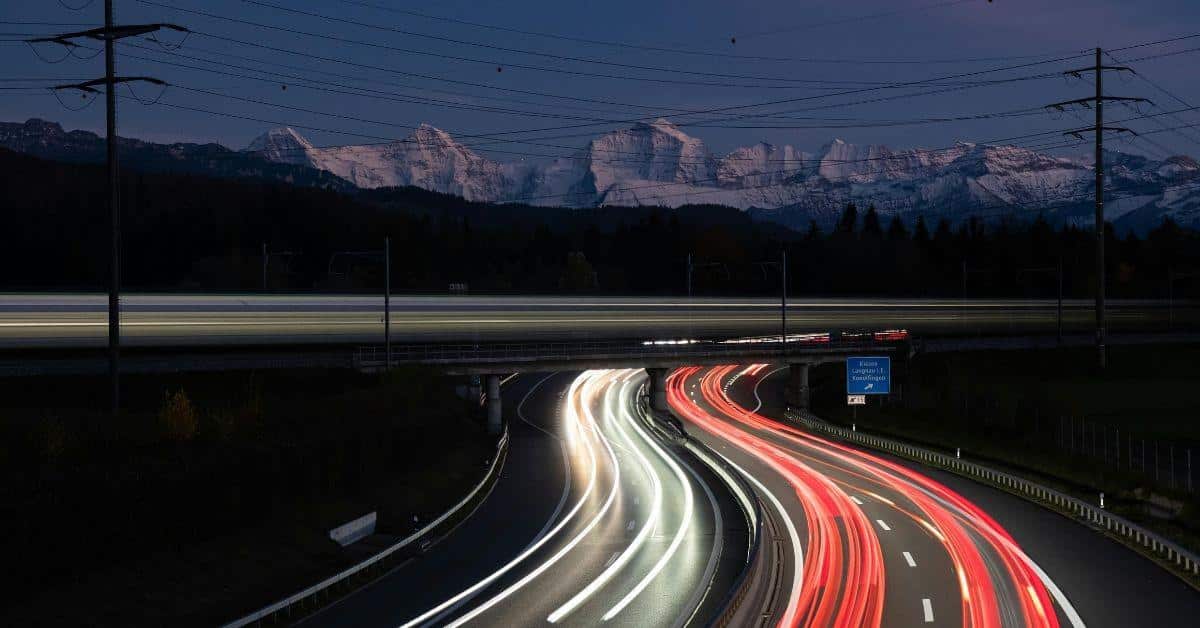
For decades, Ontario’s Highway 401 has been recognized as the busiest highway in North America and is widely regarded as the busiest highway in the world. Officially known as the Macdonald-Cartier Freeway, this critical transportation corridor forms the backbone of Canada’s economy, stretching 828 kilometres from Windsor at the US border to the Quebec boundary.
In the Greater Toronto Area (GTA), traffic volumes reach extraordinary levels, making Highway 401 a global example of roadway capacity, freight movement, and urban transportation planning.
Is Highway 401 Really the Busiest Highway in the World?
The answer to this question depends on the way traffic volumes are compared. While newer data from global megacities like Los Angeles and Tokyo show strong competition, the 401 remains one of the world’s most heavily used highways.
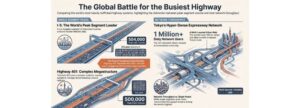
- The Single-Point Peak: Recent Federal Highway Administration (FHWA) data show segments of Interstate 5 in Los Angeles carry 504,000 vehicles daily, surpassing the 401’s peak AADT of 450,300.
- The Network Champion: Tokyo’s Shuto Expressway processes more than 1 million vehicles daily across its entire integrated system. However, its individual routes carry fewer vehicles per segment than the 401.
- The Surge Capacity King: China’s G4 Expressway handles massive holiday spikes where national volumes reach 70 million vehicles in a single day.
Even if specific points in California have more cars, Highway 401 is often considered “busier” because it maintains extreme volumes over a continuous 50-kilometre corridor through Toronto. Most busy highways see their numbers drop off quickly outside of a single major interchange, but the 401 stays packed for its entire trek through the city.
The Toronto Core: The Busiest Stretch of Highway 401
The section of Highway 401 through the Greater Toronto Area (GTA) is an engineering achievement designed to move hundreds of thousands of people every single day. Between Highway 427 and Highway 404, the road handles an average of 450,300 vehicles daily. On peak days, daily traffic often rises above 500,000.
To manage the large number of cars and trucks, the highway expands to as many as 18 lanes in certain sections near Pearson International Airport. It uses a complex “collector-express” system. This design separates short-haul local trips from the long-distance freight and provincial trade flows. This separation allows the 401 to maintain a higher capacity over a longer continuous stretch than almost any other road on the planet.
Understanding the Numbers: What Does “Busiest” Mean?
Experts use a specific metric called Annual Average Daily Traffic (AADT) to rank highways. This number is the total volume of vehicles on a road segment over a full year divided by 365 days. It balances out periods of heavy traffic, such as summer road trips, and lighter traffic during holiday weekends.
However, “busyness” can be measured in different ways. A road can be “busy” in different ways:
- Peak Single-Segment AADT: The highest number of cars passing a single specific point.
- Sustained Urban Density: High volumes are maintained over a long distance.
- Total Network Volume: The total number of vehicles across a whole web of connected expressways.
The Global Challengers: Who Rivals the 401?
While the 401 is one of the world’s busiest highways, it faces stiff competition from major metropolitan areas in the United States and Asia.
Interstate 5 – Los Angeles, California
Recent data from the Federal Highway Administration shows that specific segments of I-5 in Los Angeles have actually surpassed the 401 in raw AADT. One stretch in the LA-Long Beach-Santa Ana area carries more than 504,000 vehicles daily. This highway is the primary north–south transportation corridor on the US West Coast and faces heavy demand from both commuters and more than 50 million annual tourists.
Shuto Expressway – Tokyo, Japan
In terms of total network volume, Tokyo ranks the highest. The Shuto Expressway network handles over 1 million vehicles daily across its integrated web of viaducts and tunnels. While single segments like the Bayshore Route peak at around 163,000 vehicles, the overall density of the network makes it one of the busiest environments for a driver.
G4 Expressway – China
China’s G4 Expressway, linking Beijing to Hong Kong and Macau, is defined by its extreme surge capacity. During holiday periods like the Spring Festival, national expressway volume can hit 70 million vehicles in a day. The G4 serves as a massive funnel for these travelers.
Traffic Comparison: Global Heavyweights
The table below compares Highway 401 with some of the world’s busiest and most heavily traveled highways.
| Highway | Location | Peak Daily Volume (Approx.) | Key Feature |
| Interstate 5 | Los Angeles, USA | 504,000 | Highest single-point AADT |
| Highway 401 | Toronto, Canada | 450,000-500,000 | Sustained density over 50km |
| Shuto Network | Tokyo, Japan | 1,000,000+ | Total daily network throughput |
| Interstate 405 | Los Angeles, USA | 383,500 | Known as the most “congested” |
| Katy Freeway | Houston, USA | 320,000 | Widest at 26 lanes |

The Logistics Paradox: Busy vs. Congested
In traffic science, the “busiest” road is not always the most “congested”. A massive 18-lane highway like the 401 can process 450,000 vehicles with fewer delays than a 10-lane highway handling 300,000 vehicles. For example, the 401 often maintains an average speed of 56 km/h even at peak times. In contrast, the I-405 in LA or the M25 in London often descends into much lower speeds because they lack the same lane capacity.
For logistics companies like Lading Logistics, understanding this difference is important. High volume is manageable if the infrastructure is designed to handle it. The real risk to supply chains comes from traffic jams and not having enough road capacity to handle demand.
Why the 401 Stays So Crowded
Several factors contribute to Highway 401’s consistently high traffic volumes.
- Linear Geography: Canada’s population is arrayed in an east-west line across the south. There are often no viable alternatives for many national, provincial, or local trips.
- The 407 ETR Factor: The 407 ETR Factor: Highway 407 is a nearby tolled alternative to Highway 401 that was developed to help improve traffic flow in the Greater Toronto Area. However, many drivers and freight operators continue to rely on the free 401 for daily travel and goods movement.
- Just-In-Time Delivery: The highly integrated auto industries of Ontario and Michigan rely on the 401. It is the world’s busiest truck route, carrying 60% of all vehicular trade between Canada and the US.
- Urban Sprawl: Lack of high-density housing near jobs forces people to live further away. This locks residents into long, daily highway commutes.
The Future of the Macdonald-Cartier Freeway
Ontario recently added 134 km of new lanes to the 401 between 2016 and 2024 to reduce congestion. Despite this investment, travel times in the core Toronto bottleneck actually worsened, increasing from 25 minutes to 32 minutes for the same stretch.
This phenomenon is known as induced demand. When you make a road larger and faster, more people choose to drive, which eventually returns the highway to its previous level of congestion.
To address this, the Ministry of Transportation (MTO) is investing in multi-modal solutions. Their 2025-2026 budget allocates 60% of expenditures to transit projects, such as the Ontario Line subway and GO Train expansion. The goal is to increase rail travel through the corridor instead of adding more highway lanes.
Closing Thoughts
Is the 401 the busiest highway in the world? It depends on how it is measured. Highway 401 is known for carrying a large amount of traffic over a long urban stretch. For trade and logistics, it is more than just a highway; it is an important corridor that supports the North American economy.
Smart routing and reliable partners help businesses transport freight efficiently along these busy routes. With the opening of the Gordie Howe International Bridge in 2026, the 401 is expected to become an even more important trade corridor.
FAQs
What is the busiest highway in the United States?
Specific segments of Interstate 5 in the Los Angeles area currently have the highest traffic counts, carrying 504,000 vehicles daily.
Which Tokyo expressway route is the most iconic for racing?
The Bayshore Route (Wangan-sen) is world-famous for its role in Japan’s 1990s street racing subculture and media like Wangan Midnight.
How do 401 traffic volumes compare to the Shuto network?
The 401 handles more vehicles at its busiest single point (~450k-500k), but the Shuto network processes over 1 million vehicles total across its entire web each day.
How do 401 volumes compare specifically to Tokyo’s Bayshore Route?
The 401 is significantly busier per segment; the Bayshore Route’s peak volume is approximately 163,000 vehicles daily, which is less than half of the 401’s core volume.
Does the 407 ETR successfully reduce Highway 401 traffic?
Although drivers have another option, high toll rates discourage many motorists and commercial fleets, so most traffic stays on the 401.