

In business, estimating inventory needs is critical, as it can lead to either excess stock or out-of-stock situations.
Inventory forecasting is a quiet part of the shopping experience, which works in the background. When it is managed well, products stay available on shelves and deliveries remain smooth. When it fails, businesses face losses from unsold stock, and customers are left frustrated by out-of-stock items.
For years, companies relied on basic calculations and past sales data to forecast demand. However, in 2026, this approach has changed significantly. Machine Learning (ML), a branch of Artificial Intelligence (AI) that learns from data patterns, is transforming forecasting based on predictions into a far more accurate, data-driven process.
Limitations of Traditional Forecasting Methods
Traditional forecasting methods are like trying to drive a car while looking only in the rearview mirror. They rely heavily on historical data, which means they look at what happened last year to predict what will happen tomorrow.
While this worked in a simpler time, today’s market is too volatile. Unexpected events, like global health crises or sudden social media trends, can change what people want to buy in an instant. Older methods often struggle with these sudden shifts because they cannot adapt quickly. Furthermore, these traditional systems often require manual data entry, which is slow and prone to human error.

Traditional Forecasting vs Machine Learning in Inventory Forecasting
The following table highlights the key differences between traditional forecasting and machine learning:
| Aspect | Traditional Forecasting | Machine Learning (ML) |
| Data Used | Historical sales data only | Real-time, historical, and external data |
| Approach | Manual and rule-based | Automated and data-driven |
| Accuracy | Limited in dynamic markets | High adaptability and precision |
| Response to Change | Slow to adapt | Learns and adjusts quickly |
| Data Sources | Mostly internal data | Internal and external signals (weather, trends, social media) |
| Risk of Error | Higher due to manual processes | Lower due to automated learning |
| Decision Making | Based on past trends | Based on patterns and predictions |
The Machine Learning Advantage
Machine learning is improving how forecasting is done. Instead of just looking at past sales, ML algorithms can process vast amounts of “noisy” and complex data in real-time. They don’t just look at sales; they can consider weather patterns, economic shifts, and even social media signals to understand what customers might want next.
One of the most powerful tools in this new era is the Gated Recurrent Unit (GRU). It works like a smart memory system in a computer. It allows the system to remember important long-term trends while quickly updating its “thoughts” when new information arrives. This makes it much better at spotting the subtle patterns that humans or simple calculators might miss.
Predicting the “Unpredictable”: New Product Launches
Perhaps the hardest task in business is the cold-start problem, trying to forecast demand for a product that has never been sold before. Without a sales history, how do you know if a new gadget will be a hit or a flop?
The future of ML solves this by using analog information. The system looks at “static descriptors”, things like the brand, price, and category of the new item, and compares them to thousands of similar historical products. By seeing how those “cousin” products performed, the AI can generate a predictive distribution (a range of likely outcomes) for the new item before it is launched in the market.
Moving from “What” to “How”: Predictive-Prescriptive Thinking
The next major shift we are seeing in 2026 is the move from predictive to prescriptive analytics.
In the past, a computer might tell a manager, “I think you will sell 100 units next week.” This is a prediction. The future of machine learning, however, is a Hybrid AI Framework. This system doesn’t just predict; it prescribes an action. It looks at the forecast, considers the cost of shipping and the reliability of the supplier, and then says, “To make the most profit, order exactly 105 units from Supplier A on Tuesday”.
By integrating the forecast directly with the business decision, companies can reduce inventory costs by over 15% and cut down on “stockouts” (running out of items) by up to 65%.
Three Trends Defining the Future
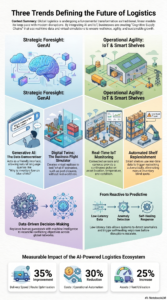
Several key technologies are currently merging to create a fully autonomous supply chain:
Generative AI (GenAI):
This is the biggest disruption of the current year. Beyond just calculating numbers, GenAI acts as a friendly interface that democratizes data. A warehouse manager can now simply ask a chatbot, “Why is the inventory low on blue shirts?” and get a clear, spoken answer based on complex data.
Digital Twins:
This works as a flight simulator for your business. Companies create a virtual replica of their entire supply chain, every truck, warehouse, and store. They can then test “what-if” scenarios, like a port closure or a sudden surge in orders, to see how the system would react without risking real money.
IoT and Smart Shelves:
The Internet of Things (IoT) refers to objects connected to the internet. Future warehouses will use smart shelves with weight sensors and cameras that talk directly to the forecasting AI. The moment a shelf gets light, the system knows instantly, allowing for automated replenishment.
Real-World Success Stories
This is no longer a future concept; according to a report analysis, major companies are already seeing actual results:
- Walmart uses 1,500 cameras and hundreds of sensors in its “Intelligent Retail Lab” to track stock in real-time, leading to a 30% decrease in out-of-stock items.
- Zara uses machine learning to process over 1 billion data points daily, allowing them to adjust their fashion production almost instantly based on what is selling in stores.
- H&M applied AI to manage trends across 5,000 stores, which increased profits by roughly 30% while also reducing waste.
Current Challenges in AI-Driven Forecasting
There are still challenges in 2026 despite all the progress. Many companies face a “digital talent shortage,” where they have the software but not enough skilled people to manage it. There are also deep concerns about data privacy, as AI requires access to massive amounts of sensitive information to work effectively.
Finally, there is the issue of algorithmic bias. If an AI learns from biased data, for example, favoring a supplier just because they are large, it can lead to unfair or risky business decisions.
Closing Insights
The future of inventory forecasting is no longer about looking backward; it is about looking forward with clarity and speed. Today, machine learning has moved from an optional tool to an essential foundation for any business that wants to survive.
While challenges like privacy and the need for new skills remain, the benefits are undeniable. We are entering a time of “profitable balance”, where businesses save money, waste is reduced, and customers always find exactly what they need, right when they need it. Thus, Inventory forecasting has moved past guesswork entirely.