
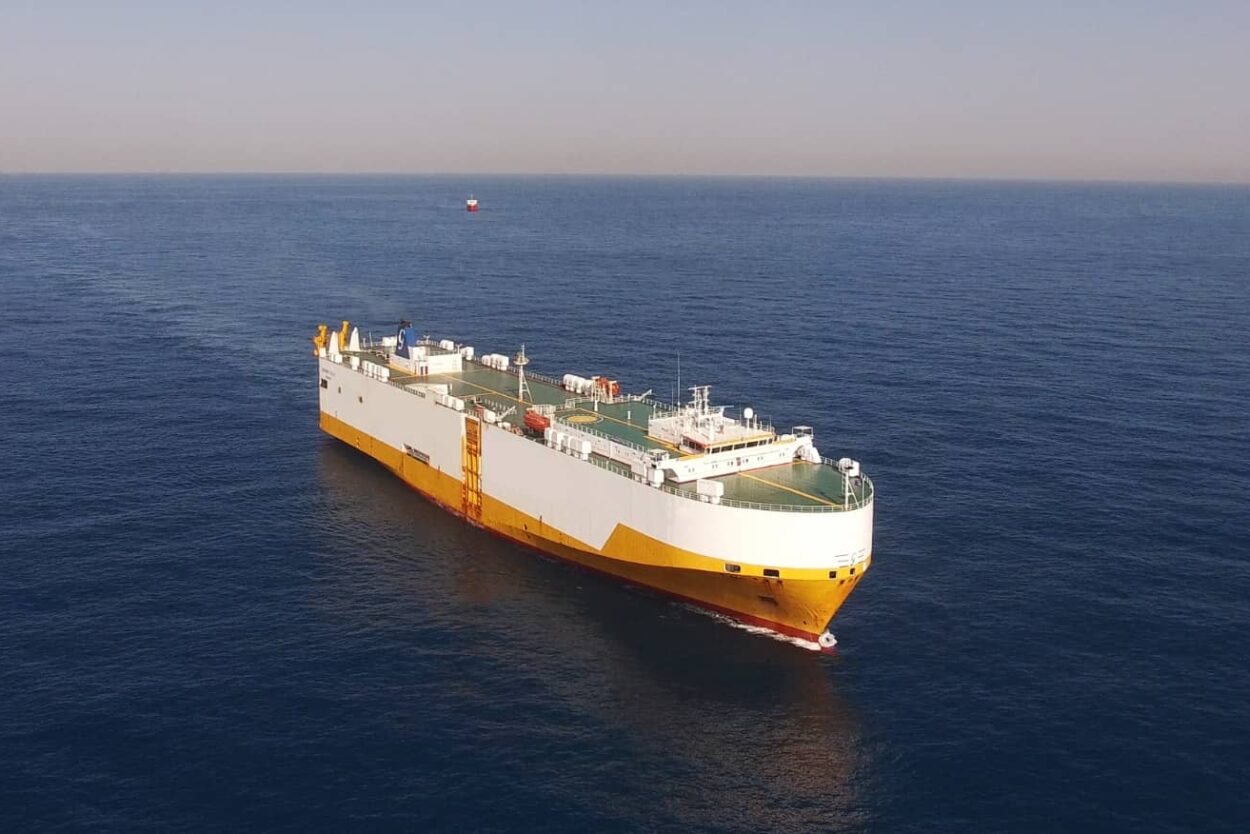
Mexico’s automotive industry continues to play a major role in North American trade, with most vehicles produced in the country exported to the United States. At the same time, new logistics investments in Texas and California are strengthening freight networks across the region.
This week in Borderlands Mexico, we take a look at the latest developments in the U.S. Mexico cross-border trucking and trade:
- Mexico’s automakers continue to export vehicles to the U.S., led by General Motors and Stellantis.
- BNSF Railway has started building a $500 million logistics center north of Dallas.
- Maersk opens a new ground freight hub in Fontana, California, to speed up deliveries in Southern California.
Mexico’s Auto Industry: Exports Still Strong
Mexico’s automotive sector produced 311,457 light vehicles in February, a slight decline of 1.8% from last year. Exports fell 4.4%, totaling 247,945 vehicles.
Even with the small slowdown, the industry is still heavily export-driven, especially to the U.S.
In the first two months of 2026, Mexico made 625,774 vehicles, down 0.6% from last year, while exports reached 485,426 vehicles, up 1.4%.
About three-quarters of vehicles built in Mexico are sent to the U.S., showing how closely the two countries’ automotive industries are connected.
Mexico hosts major assembly plants for General Motors, Stellantis, Ford, Toyota, Volkswagen, Volvo, and BMW, with large production clusters in Coahuila, Nuevo León, Guanajuato, Puebla, and San Luis Potosí. Vehicles and parts move daily across the border by truck and rail.
U.S. Remains the Biggest Market
From January through February, 75.7% of Mexican vehicle exports went to the U.S., followed by Canada (12.1%), and other markets like Germany and Colombia.
This shows that Mexico’s production is closely linked to U.S. demand, with many vehicles assembled south of the border sold in America.
Top Producers: GM and Stellantis
In February, General Motors led production with 69,652 vehicles, followed by Stellantis (40,865), Nissan (40,214), and Ford (31,508).
Exports followed a similar trend:
- GM: 57,473 vehicles
- Stellantis: 30,401 vehicles
- Ford: 28,958 vehicles
- Nissan: 27,800 vehicles
- Toyota: 26,190 vehicles
Most vehicles being produced are light trucks and SUVs, making up about 80% of total production.
BNSF Railway Starts $500M Logistics Center
BNSF Railway has broken ground on a 944-acre logistics park in Gunter, Texas, about an hour north of Dallas.
The $500 million project, called Logistics Center North Dallas, will feature direct rail service and ready-to-build industrial sites. The first phase should take about 19 months to finish.
The new center will help shippers expand supply chains and improve access to the fast-growing Dallas-Fort Worth logistics corridor.
Maersk Opens New Hub in Fontana
A.P. Moller-Maersk has opened a 165,000-square-foot ground freight facility in Fontana, California, part of its expanding trucking and distribution network in Southern California.
The hub includes 22 dock doors, 18 vehicles, and 24/7 operations, allowing Maersk to speed up freight by up to five hours and provide faster connections to regional and interstate markets.
This new facility complements Maersk’s other hubs in Sacramento, San Francisco, San Diego, and Los Angeles, strengthening its North American logistics network of over 65 facilities.
Bottom Line
Mexico continues to be a major hub for automotive exports, especially to the U.S. Meanwhile, logistics investments like BNSF’s Texas center and Maersk’s Fontana hub show how the region is preparing for faster, more efficient trade and freight movement across North America.