
Global logistics is changing rapidly. One of the biggest drivers of this change is trade documentation automation. This refers to the use of digital systems to automatically create, process, verify, and exchange shipping and customs documents.
In the past, trade documentation relied on paper and manual data entry. These processes were slow, costly, and prone to errors. Today, technologies such as artificial intelligence (AI), machine learning (ML), natural language processing (NLP), and robotic process automation (RPA) are changing the way documents are handled in international trade.
By implementing automation in modern logistics, businesses can operate more efficiently.
If you’re asking yourself ‘how?’, here’s the answer.
Why Automation Matters in Trade Documentation
Trade documentation is very important for international shipping. It includes all the forms, certificates, and papers needed to send goods across borders. But for a long time, it has been slow and full of problems.
Only about 1% of shipping documents are fully digital. That means 99% still use paper or half-manual processes.
Manual data entry is risky. Around 29% of mistakes in supply chains come from typing errors.
These documents are needed for customs, legal rules, contracts, and risk management. Slow or wrong paperwork can delay shipments, increase costs, or cause penalties.
Automation solves these problems by making processes faster, easier, and more accurate.
Market Growth and Projections for Automated Documentation
Automated trade documentation is not just an idea; it’s growing fast. Here’s the data:
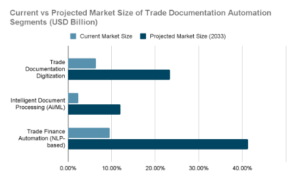
Note: Current market sizes are from 2023–2025 estimates. Projections for 2033 are based on segment-specific CAGR.
Technologies Behind Documentation Automation
Trade documentation automation doesn’t rely on just one technology; it uses many tools, such as:
AI & NLP (Natural Language Processing)
NLP works like a smart helper that reads all documents, checks for mistakes, and points out problems before they cause trouble. This helps reduce errors by up to 30%.
Moreover, AI can check packing lists, HS codes, duties, and customs rules, which makes documents more accurate and reduces compliance risks.
Robotic Process Automation (RPA)
RPA enables repetitive customs tasks automatically. For example, some companies report that customs clearance is up to 50% faster with RPA.
It also reduces manual work by 70-80% in documentation.
Intelligent Document Processing (IDP)
IDP platforms can extract data with 90%+ accuracy; therefore, it helps to reduce costs.
Some fields even reach 95%+ accuracy, and it eliminates the need for humans to check everything.
Operational Benefits of Automation
Automation gives measurable results across multiple areas of trade documentation:
Efficiency & Speed: Automatic workflows can fill and submit forms as shipments are booked, thus saving days of work. AI tools can make 40-80% document processing faster.
Accuracy & Compliance: Companies using digital documents reach 95%+ accuracy, simultaneously reducing customs delays. Automated checks help businesses stay compliant as rules change.
Cost Savings: Automation reduces the need for large teams doing manual work. In this context, some companies report up to 60% lower costs for documentation tasks.
Why Is Trade Not Fully Digital Yet?
Even with these benefits, some challenges restrict digital adoption. The main reasons are:
- Around 30% of supply chains still rely on paper.
- Different digital platforms and government systems do not always work together.
- Even though cloud solutions are easy to use, many small and medium businesses have limited budgets or technical knowledge.

How Companies Are Benefiting from Digital Documents
According to the IGTC Survey Some companies are already seeing great results:
- 89% said contract efficiency improved after moving to digital documents.
- 78% reported major benefits from process automation.
- 67% saw faster payment processing.
Between 2019 and 2022, 67% of companies increased their use of electronic documents.
These stats show that digital workflows are becoming more common, even if not universal yet.
Future of Automated Supply Chain
Paperless trade will be the future of the trade supply chain. AI and RPA will go beyond just reading and filling forms. They will help predict risks, check rules in real time, and even resolve disputes automatically.
Blockchain and digital signatures will make documents secure and trustworthy.
As these markets grow, automation will be a core tool for logistics companies to stay competitive.
Conclusion
Automated trade documentation will help to complete the process in minutes that would have taken hours manually. With the help of AI, NLP, RPA, and intelligent processing, you can experience that both accuracy and compliance are improving dramatically.
Although digital transformation offers advantages, it’s still in its early stages. However, the projected outcomes suggest that it will become the future of global logistics by offering a cost-effective, efficient, and reliable supply chain.
At Lading Cargo, we work closely with importers and exporters to simplify complex shipping procedures and ensure that trade documentation automation helps move cargo across borders faster, more accurately, and with fewer delays.
FAQs
What is trade documentation automation?
It uses computers and software to handle shipping and customs documents automatically.
Why is automation important for trade documents?
It makes work faster, reduces mistakes, and helps follow rules correctly.
How much of trade documentation is digital today?
Only about 1% of shipping documents are fully digital. Most still use paper or partly manual processes.
What benefits do companies get from automation?
Work is faster, accuracy is higher, costs go down, and payments happen quicker.
What is the future of automated trade documentation?
All documents will become digital. AI, RPA, and blockchain will make trade safer and faster.
Copyright: All rights reserved. Unauthorized reproduction or distribution of any content on this site is prohibited. For permissions, please contact https://ladingcargo.com/.