
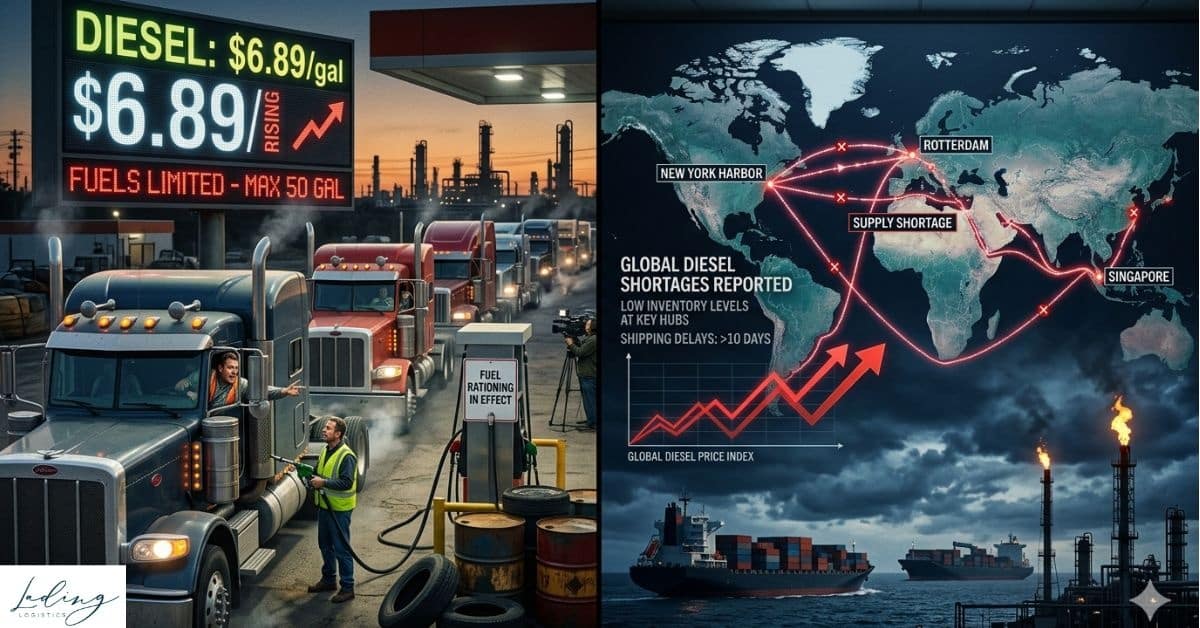
The benchmark diesel price used to calculate most fuel surcharges rose for the 11th consecutive week, although the latest increase was modest compared with the sharp gains seen in recent weeks.
According to the U.S. Department of Energy’s Energy Information Administration (DOE/EIA), the average weekly retail price for ultra-low sulfur diesel (ULSD) increased by 2.6 cents per gallon to $5.401. This is a far smaller jump than the prior three weeks, which saw increases of 96.2 cents, 21.2 cents, and 30.4 cents per gallon, respectively, following the outbreak of the Iran conflict.
Since January 12, when ULSD was $3.459 per gallon, prices have risen by nearly $1.94 per gallon over the 11 weeks. At $5.401 per gallon, diesel prices are at their highest level since November 28, 2022, when the DOE/EIA recorded $5.141 per gallon. That period followed Russia’s invasion of Ukraine, which pushed U.S. diesel prices above $5 for 32 weeks in 2022.
On the futures market, ULSD prices for April delivery settled at $4.3643 per gallon on Monday, equivalent to roughly $183.30 per barrel. Friday’s settlement was $4.4955 per gallon, or about $188.81 per barrel, while the March 20 high settlement of $4.6084 per gallon equated to $193.55 per barrel.
Market conditions remain in backwardation, with near-term delivery barrels commanding the highest prices. This structure reflects tight supply, meaning spot physical diesel, particularly for immediate delivery in key U.S. hubs such as New York Harbor, Chicago, the Gulf Coast, and Los Angeles, is expected to trade at a premium over futures prices. Wholesale suppliers typically set retail prices based on these regional spot markets, influencing street-level pump prices.
Jeffrey Currie, Chief Strategy Officer at Energy Pathways, Carlyle Group, highlighted the global nature of the supply strain. “Last week we were seeing shortages in Singapore with jet fuel at $230 a barrel. This week, Rotterdam is at $220, as are Thailand, the Philippines, New Zealand, and Australia. It’s going intercontinental,” Currie said. He emphasized that the price convergence reflects physical supply constraints rather than financial markets or policy interventions. “There’s no more price spread, no spare barrels, no policy fix–it’s just physics. You can’t print molecules,” he added.
As diesel prices continue to climb, the combination of geopolitical uncertainty and tight global supply chains suggests that both wholesale and retail prices may remain elevated for the near term.