
Freight forwarding plays an important role in international trade, as it helps businesses transport goods between countries efficiently and legally. Whether you own a small business that imports products or manage a large international supply chain, understanding how freight forwarding works can help you save time, money, and reduce risk.
Today, the global freight forwarding market is valued at approximately USD 280 billion and is expected to grow to around USD 285.6 billion by 2030. At the same time, maritime transport continues to handle nearly 80% to 90% of global trade by volume. This highlights just how dependent the world economy is on efficient logistics and well-coordinated supply chains.
This guide will explain how freight forwarders operate, the costs involved, the required documentation, and the latest industry trends.
Let’s begin :-
What is Freight Forwarding?
Freight forwarding is the professional management and coordination of transporting cargo across international borders. It is a service that helps businesses move goods efficiently by combining different types of transport, managing customs regulations, and reducing risks.
Role of a Freight Forwarder
A freight forwarder acts as a strategic intermediary, or middleman, between the person shipping the goods and the service providers that move them. Their job is to find the best balance of cost, speed, and reliability for your shipment.
For example, imagine a freight forwarder as a travel agent for cargo. Just as a travel agent organizes your flights and hotels without owning the airline, a forwarder coordinates your shipment’s entire journey without typically owning the ships or planes themselves.
Freight Forwarder vs. Shipping Carrier
It is easy to get these two confused. A shipping carrier is the company that actually owns the equipment (like a ship, plane, or truck) and physically moves the goods. A freight forwarder is the expert who hires those carriers, handles the paperwork, and ensures your cargo moves through the supply chain smoothly.

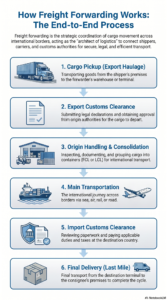
How Freight Forwarding Works (Step-by-Step Process)
The international movement of goods follows a multi-stage process that requires careful coordination and timing.
-
Cargo Pickup (Export Haulage)
The journey starts with export haulage, which is the movement of goods from your warehouse to the freight forwarder’s facility or a port. This is usually carried by truck or rail and can take anywhere from a few hours to several days.
-
Export Customs Clearance
Before your goods can leave their country of origin, they must be approved by local authorities. A licensed customs broker submits documents to ensure the shipment follows all export laws.
-
Origin Handling and Consolidation
Once the goods reach the forwarder’s warehouse, they are inspected for damage and verified against the shipping documents. If you have a small shipment, it might be consolidated, which means it is grouped with other people’s cargo into one container to save you money.
-
Main Transportation
This is the central part of the trip where your goods travel across the world via sea, air, road, or rail. During this phase, modern forwarders use real-time tracking so you always know where your cargo is located.
-
Import Customs Clearance
When the cargo arrives in the destination country, it must clear another customs check. Authorities review the paperwork and classify the goods to determine what taxes or “duties” you need to pay.
-
Final Delivery (Import Haulage)
The last step is import haulage, where the goods are delivered from the destination warehouse to the final receiver (the consignee). This “final mile” completes the door-to-door cycle.
Types of Freight Forwarding Services
The choice of shipping method depends on factors such as budget and delivery urgency. The main types of freight forwarding services include:
- Air Freight Forwarding: The fastest option, moving goods across continents in just days. It is more expensive but very secure. It’s perfect for high-value items like electronics or urgent medical supplies.
- Sea Freight Forwarding: This is the dominant mode of global trade, handling about 80% to 90% of all trade.
- FCL (Full Container Load): When you rent an entire container for your goods.
- LCL (Less-than-Container Load): You share space with others and only pay for the volume you use.
- Road Freight Services: Highly flexible, as they can provide door-to-door delivery and easily adapt routes and schedules. They are essential for last-mile delivery to shops or warehouses.
- Rail Freight Logistics: An efficient middle ground that is faster than sea transport but more cost-effective than air transport. It is becoming increasingly popular for routes between China and Europe.
- Multimodal Transportation: This is when a single provider uses two or more modes (like combining a truck and a ship) under one contract to simplify the process for you.
Benefits of Using Freight Forwarding Services
There are several important benefits of using freight forwarding services.
- Cost Efficiency: Freight forwarders negotiate lower rates by shipping large volumes and also offer consolidation services for smaller loads.
- Time Savings: They manage the entire shipping process, including documentation, coordination, and transport, allowing businesses to focus on core operations.
- Reduced Risk: Experienced forwarders plan for potential disruptions such as port congestion, strikes, or adverse weather conditions, which helps ensure more reliable deliveries.
- Global Access: You get access to an extensive worldwide network of agents and partners that would be difficult to manage independently.
- Customs Expertise: They stay updated with changing international trade laws to help you avoid delays, penalties, and compliance issues.
Freight Forwarding vs. Logistics vs. Shipping Carrier

To better understand how freight forwarding operates within the wider supply chain industry, it is helpful to compare it with logistics management and shipping carriers.
| Aspect | Freight Forwarding | Logistics Management | Shipping Carrier |
| Primary Role | Strategic Coordinator | End-to-End Supply Manager | Physical Transporter |
| Main Function | Arranges and documents | Manages the overall flow of goods | Moves goods physically |
| Ownership | Asset-Light (Expertise-based) | Strategic/Integrated systems | Asset-Heavy (Ships, Trucks, Aircraft) |
This comparison highlights that freight forwarders focus on coordination and planning, logistics covers broader supply chain management, while shipping carriers are responsible for the physical movement of goods.
Conclusion
Freight forwarding is not just about shipping goods. It helps your business sell and expand internationally. Freight forwarders plan and organize everything involved in shipping, such as documentation, customs clearance, transportation routes, and regulations. They handle the major parts, so you can focus on growing your business. It is important to choose the freight forwarding partner responsibly if you want to grow your business internationally.
FAQs
What is freight forwarding in simple terms?
It is a professional service that organizes and manages the international shipping of goods.
Is a freight forwarder necessary for small businesses?
While not legally required, they are practically essential for understanding complicated international laws and avoiding expensive customs mistakes.
How much do freight forwarders charge?
They earn money through freight margins (the difference between what they pay the carrier and what they charge you) and flat service fees.
What is the difference between freight and shipping?
In this industry, “freight” refers to the goods being moved, while “shipping” often specifically refers to movement via waterborne vessels.
Do freight forwarders handle customs clearance?
Yes, most forwarders have in-house experts or work with licensed customs brokers to handle the entire border process for you.