

How can companies predict problems and keep their supply chains working well, even in uncertain times? predictive analytics in supply chain.
Supply chains play a significant role in the world’s business activities. Supply chains link manufacturers, suppliers, distributors, and customers from the raw materials to the final product. In the last few years, the world’s supply chains have experienced several disruptions, such as the COVID-19 pandemic, geopolitical issues, natural disasters, and shifts in demand patterns. These have shown that the world’s supply chains are highly vulnerable.
For this reason, companies are now finding ways to predict problems before they happen. So, there comes predictive analytics in the supply chain. It uses historical data, advanced algorithms, and digital technologies to help organizations forecast future situations and make better decisions.
By 2030, predictive analytics is expected to become an important tool in building resilient supply chains.
What is Predictive Analytics?
Predictive analytics is the use of data, statistical models, and machine learning to predict future results. It prevents problems from occurring since the patterns can identify the risks in advance.
For example, predictive analytics can help companies:
- Assess customer demand more accurately
- Identify possible supplier delays
- Predict transportation issues
- Optimize inventory levels
As a result, organizations can respond faster and avoid costly disruptions.

Why Supply Chain Resilience Matters
Supply chain resilience enables the supply network be prepared for challenges and respond smartly. Now, supply chains are more complex and interconnected worldwide than ever before. It undoubtedly increases efficiency, but vulnerabilities also increase.
For example, a delay from one supplier can affect multiple companies across different regions. Therefore, businesses must adopt technologies that allow them to monitor risks and act accordingly.
How Predictive Analytics Improves Supply Chain Resilience
Predictive analytics supports supply chain resilience in several important ways.
- It helps in demand forecasting. Thus, companies can analyze past sales, seasonal trends, and market signals to predict customer demand precisely. It prevents both shortages and excess inventory.
- Predictive tools help identify supplier risks. If a supplier shows signs of delays or capacity issues, companies can quickly switch to alternative sources.
- Predictive analytics improves logistics planning. Transportation data can help to understand delays caused by weather conditions, traffic congestion, or port disruptions.
- Predictive insights support better inventory management. By analyzing demand patterns, businesses can maintain optimal stock levels and avoid unnecessary storage costs.
Consequently, these improvements make supply chains more flexible and responsive.
Predictive Supply Chain Technologies
Several digital technologies support predictive analytics in supply chains.
With the help of Artificial Intelligence (AI) and Machine Learning, systems process large amounts of data and get the patterns that humans might miss.
Meanwhile, the Internet of Things (IoT) provides real-time data from sensors located in warehouses, trucks, and manufacturing facilities.
In addition, cloud computing allows companies to store and process large datasets efficiently. Because of these technologies, businesses are now able to monitor supply chain activities in real time and make faster decisions.
As technology advances, predictive supply chains will become even more intelligent and automated.

Key Benefits for Businesses
Companies that use predictive tools are experiencing many benefits, such as:
- They can reduce operational risks and provide better service.
- They can also save on inventory and transportation costs.
- Moreover, predictive insights allow businesses to react quickly to changes in the market
For example, a retailer that predicts a sudden increase in demand can increase inventory in advance. Similarly, a manufacturer can identify supplier issues early and adjust production schedules accordingly.
Therefore, predictive analytics not only makes operations more efficient but also helps businesses maintain stability in the long term.
Growing Adoption of Predictive Analytics
Many organizations have already started investing in predictive analytics to strengthen their supply chains. According to several industry reports, the use of data-driven technologies in supply chain management is growing rapidly. Here, in this table, you can see the growing percentage of companies using predictive analysis.
| Year | Percentage of Companies Using Predictive Analytics |
| 2018 | 17% |
| 2020 | 24% |
| 2022 | 38% |
| 2024 | 47% |
| 2030 (Projected) | 65% |
This data shows a clear trend. Over the past decade, more companies have started using predictive analytics to manage risks and improve decision-making. By 2030, it is expected that nearly two-thirds of companies will rely on predictive technologies in their supply chain operations.
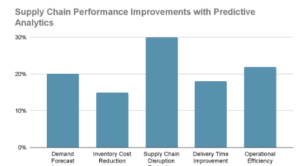
Supply Chain Performance with Predictive Analytics
The impact of predictive analytics can also be seen in supply chain performance metrics.
Challenges in Implementing Predictive Analytics
Despite its benefits, implementing predictive analytics is not always simple. Let’s understand the challenges:
- Data Quality: Predictive models require accurate and consistent data. If the data is incomplete or outdated, predictions may not be reliable.
- Technology Integration: Many organizations still use legacy systems that are difficult to connect with modern analytics platforms.
- Skilled Professionals: Companies need professionals who understand data science and supply chain management. Insufficient expertise can make it difficult to fully benefit from predictive tools.
However, as digital transformation continues, many of these challenges are gradually being addressed.
Future of Supply Chains by 2030
Over the coming years, more businesses will be using predictive analysis to manage their business uncertainties. Instead of assumptions, companies will depend on the real-time data, analytics, and technology to guide areas like:
- How much inventory to keep
- Which suppliers to use
- The fastest shipping routes
- Predicting problems before they happen
As a result, businesses will be better prepared to handle global challenges while keeping customer satisfaction.
Conclusion
In the end, predictive analytics offers solutions to predict future aspects and progress accordingly. It requires a skillful team and technologies to get and read the patterns and suggest to the companies the best way possible. So, by the year 2030, companies will be more certain about their supply chains in this uncertain world.
Copyright: All rights reserved. Unauthorized reproduction or distribution of any content on this site is prohibited. For permissions, please contact https://ladingcargo.com/.