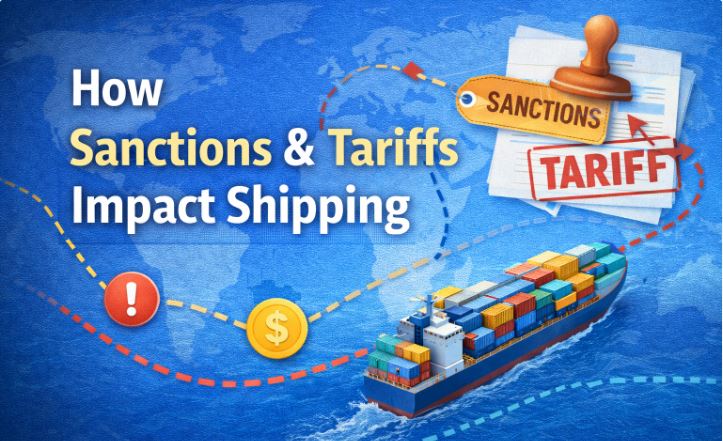
Have you looked at a global shipping map lately? If you have, you probably noticed something strange. Ships aren’t moving in straight lines anymore. A few years ago, the goal of shipping was simple. It was to get a product from point A to point B as fast as possible. But today, in 2026, things are different.
Now, the goal is to get your products there safely and without a massive, surprise tax bill. Sanctions and tariffs have become “invisible walls.” They decide which way your cargo travels and how much you eventually pay. For anyone running a business, understanding how sanctions tariffs shipping dynamics reshape global routes is the only way to keep your customers happy and control your costs.
Why Are Your Global Shipping Routes Getting Longer?
For a long time, the Suez Canal was everyone’s favorite shortcut. It helped ships travel faster and use less fuel. But today, that shortcut can be a trap. Because of sanctions on certain regions and the risk of conflict, insurance companies have raised their prices for ships entering those waters.
As a result, many ships now sail around the southern tip of Africa instead. While this adds time and fuel costs, a longer and safer route often provides more predictable schedules and lower insurance risk.
How Do Tariffs Drive the Growth of “Friendshoring”?
You probably hear the word “tariffs” in the news all the time. From a cost perspective, a tariff is a tax on goods coming from a specific country. If the tax on a product from “Country A” is 30%, your profit on that product basically disappears.
To avoid this, many businesses now use a strategy called Friendshoring. Instead of shipping directly from a high-tax country, goods are sent through “friendly” third-party countries like Vietnam, Mexico, or India.
It has become a strategic process of connecting the dots to identify the lowest tax rate. This approach highlights how sanctions tariffs shipping decisions now play a central role in global supply chain planning.
Why Are Green Taxes Changing the Path Your Goods Take?
In 2026, there is a new kind of tax that is unrelated to war or geopolitics. It focuses on environmental impact. Many places, like Europe, now use a “carbon tax.”
If your goods travel on an old, smoky ship that burns dirty fuel, you will pay a higher tax when the cargo lands. Because of this, global shipping routes are shifting toward “Green Corridors.” These are specific paths between ports that are set up to handle clean, modern ships.
As a business leader, you have to realize that the “cheap” old ship might actually be costing more in the long run because of these environmental taxes. Choosing a cleaner ship isn’t just good for the planet; it makes financial sense in the long run.
What Are the Legal Risks of Using the “Shadow Fleet”?
There is a risky side to shipping that you need to be aware of. It is called the Shadow Fleet. These are old, often uninsured ships that turn off their GPS trackers to hide where they are going. They carry goods that are under sanctions, like oil or electronics, between countries that aren’t supposed to be trading.
If your cargo is linked to a Shadow Fleet vessel, your company could face blacklisting, seized goods, and loss of banking access. Verifying vessel history before shipment is essential.
How Do Digital Ports Reduce Your Shipping Delays?
Sanctions don’t just change where a ship sails; they change how long it sits at the dock. Every time a new sanction is passed, customs officers have to check boxes more carefully. This creates “paperwork friction.”
Routes that go through ports with old, slow computer systems are being avoided. Even if that port is closer, a two-week delay at the border is a disaster for your supply chain. Modern routes now prioritize “Digital Ports,” which instantly verify goods’ origins.
How Can You Lower Your Total Shipping Costs in 2026?
It feels like a lot to manage, but you don’t have to be a shipping expert to stay safe. Here are three things you can do:
- Don’t just look at the freight price. The lowest price to move a container might be hiding a massive carbon tax or a “sanction risk” fee. Always ask for the Total Landed Cost.
- Know your partners. Ask your shipping company for proof of their history. If they can’t show you exactly where their ships have been for the last six months, don’t work with them.
- Build in extra time. The “Just-in-Time” model is very hard to do right now. Since routes are longer and customs checks are stricter, try to keep a little extra stock in your warehouse.
Summary
The world isn’t getting smaller, but shipping rules are stricter than ever. Sanctions and tariffs are reshaping routes, with longer paths and cleaner fuel now essential to avoid high taxes and legal risks.
At Lading Logistics, we help businesses navigate these changes so cargo keeps moving safely. By prioritizing compliance and smart routing over speed alone, you protect your business from fines and lost shipments. In 2026, the best leaders know exactly where their goods are on the high seas.
FAQs
Is “Friend shoring” legal?
Yes, as long as rules are followed. Some part of the product must be made or finished in the “friendly” country to legally change its origin.
Why are my shipping costs going up even when fuel is cheap?
Insurance is a big reason. Insuring a ship that travels through “risky” or “sanctioned” areas is incredibly expensive. You are often paying for safety, not just fuel.
What is a “Green Corridor”?
It is a shipping route between two ports that is optimized for clean ships. These routes often have lower taxes and faster processing times because they meet environmental standards.
Can I get in trouble if my shipping company breaks a rule?
Yes. As the owner of the goods, you can be held responsible for who you hire. That is why it is so important to work with transparent companies that track their ships in real-time.
Should I stop using shortcuts like the Suez Canal?
Not necessarily, but you should have a backup plan. If a new sanction or conflict starts, that shortcut could close overnight. Always know your “Route B.”