
In the modern supply chain, the shortest link is often the most crucial. Last-mile delivery is the final stage of the logistics process, where goods are transported from a distribution hub, local warehouse, or retail location directly to the customer’s doorstep. While this segment covers the smallest geographic distance, it has become the most complex, expensive, and critical phase of modern commerce. As global e-commerce sales are projected to hit $7 trillion by 2025, the last mile has shifted from a back-end necessity to a front-end brand identifier and competitive differentiator.
Economic Architecture of the Final Leg
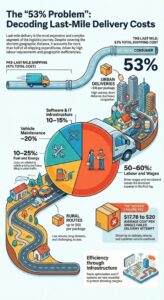
The primary challenge of the last mile is its high cost. Industry data consistently indicates that this final stage accounts for 53% of total shipping costs. This represents a significant increase from 2018, when last-mile costs were roughly 41% of shipping budgets.
This fiscal burden results from several systemic factors:
- Labor and Wages: Drivers account for 50% to 60% of total last-mile expenses. In competitive markets like the U.S., express delivery drivers earn a premium for the speed and reliability demanded by the “Amazon Effect”.
- Fuel and Inefficiency: Fuel accounts for 10% to 25% of costs. In dense urban centers, delivery vehicles may average only 6.5 miles per gallon due to constant idling and traffic congestion.
- The Crisis of Failed Deliveries: Approximately 5% to 8% of deliveries fail on the first attempt, often due to incorrect address data or recipient unavailability. Each failure costs a business between $17.78 and $20.00, leading to cumulative annual losses in the hundreds of billions.
Technological Innovations: AI and Intelligent Routing
To survive the margin-compression of “free shipping” expectations, businesses are turning to AI-driven Transportation Management Systems (TMS). Traditional static routing can no longer handle the volatility of urban logistics.
Modern AI solutions offer:
- Dynamic Route Optimization: Algorithms analyze traffic, weather, and vehicle capacity in real-time to shorten routes and reduce idle time, potentially cutting operational costs by 10% to 25%.
- Precise Geocoding: 45% of failed deliveries are caused by address errors. Advanced geocoding engines convert unclear or incomplete addresses into exact GPS coordinates, allowing drivers to locate exact entrances or loading docks instantly.
- Real-Time Visibility: Transparency is now a baseline expectation, with 91% of consumers actively tracking their packages. Systems providing live GPS maps and updated ETAs reduce customer anxiety and the likelihood of failed attempts.
Challenges and Solutions for Each Last-Mile Cost Driver
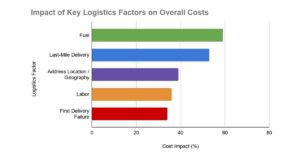
The graph above shows which logistics factors drive the highest costs. The table below summarizes the key challenges and the strategies companies are adopting to tackle them.
| Key Challenge | Solution |
| Rising fuel costs and environmental impact | Transition to electric vehicles (EVs) and optimize delivery routes to reduce mileage and emissions. |
| Traffic congestion, failed deliveries, and high labor demands | Use micro-fulfillment centers (MFCs), AI-driven route optimization, and parcel lockers/OOH pickup points to improve efficiency. |
| Urban congestion vs. long rural distances | Deploy drones for hard-to-reach rural areas and sidewalk robots in dense urban zones for faster delivery. |
| Driver shortages and high recruitment costs | Implement automation in fulfillment centers, AI dispatching, and autonomous last-mile delivery robots to reduce dependence on human drivers. |
| Delivery failures due to absent recipients or incorrect addresses | Introduce parcel lockers, OOH pickup points, AI address verification, dynamic scheduling, and flexible delivery windows to reduce redelivery costs. |
Rise of Decentralized Fulfillment: MFCs and Dark Stores
To meet the demand for same-day and sub-two-hour delivery, logistics is moving “downstream.” Centralized suburban warehouses are being supplemented by Micro-Fulfillment Centers (MFCs) and Dark Stores.
- MFCs: Highly automated, compact facilities (3,000-10,000 sq. ft.) integrated into urban real backrooms or unused parking lots. An automated MFC can process 200 to 400 orders per hour, compared to just 15–25 in a traditional warehouse.
- Dark Stores: These are traditional retail locations closed to the public and repurposed solely for online order fulfillment. Converting an underperforming retail site is often 30% to 50% cheaper than building new industrial space in a city core.
These models not only increase speed but also significantly improve inventory turnover rates and shorten the “linehaul” distance, which narrows the last-mile window.
Out-of-Home (OOH) Solutions: Consolidating the Last Mile
Consolidating deliveries into Pickup and Drop-Off (PUDO) points and Automated Parcel Machines (APMs) is one of the most effective strategies for reducing costs and emissions.
These strategies deliver considerable efficiency improvements.
- Courier Productivity: A courier delivering to lockers can process up to 150 packages per hour, compared to only 15 to 30 packages for traditional home delivery.
- Sustainability: Parcel locker networks in urban areas can reduce CO2 emissions by two-thirds (or up to 82% in some ecosystems) compared to traditional door-to-door deliveries.
- Regional Leadership: Poland, often called “lockerland,” leads Europe in OOH density, with residents often living within a “slipper distance” (approx. 350m) of a locker.

Future of Unmanned Delivery: Drones and Robots
The Autonomous Last-Mile Delivery (ALMD) market is projected to grow from $21.5 billion in 2024 to over $228 billion by 2035.
- Sidewalk Robots: These low-speed “bots” accounted for 42% of the autonomous market in 2025. They are ideal for “hyperlocal” trips (under 5 miles) in urban zones and campuses, where they avoid the airspace regulations that challenge drones.
- Aerial Drones: Companies like Zipline and Alphabet’s Wing are proving successful in healthcare logistics, delivering urgent medical payloads in under 30 minutes by bypassing ground traffic.
- Autonomous Trucks: Major players are merging express, ground, and freight networks (like FedEx’s Network 2.0) to eliminate redundant routes using autonomous box trucks, aiming for billions in savings.
Sustainability: The Green Logistics Mandate
Last-mile delivery is the most carbon-intensive part of the supply chain. Regulatory shifts, such as the EU’s CO2 emissions updates and London’s ULEZ expansion, are forcing carriers to electrify their fleets.
Electric Vehicles (EVs) are uniquely suited for the last mile because city “stop-and-go” driving allows for regenerative braking, which helps extend battery life throughout a daily route. Furthermore, EVs help companies avoid the large fines associated with city “vehicle idle laws”. In dense environments, electric cargo bikes are also emerging as a superior solution, bypassing traffic jams and searching for parking, a task that currently consumes up 28% of a commercial vehicle’s total trip time.
Preparing for 2030: The Next Phase of Last-Mile Delivery
As we look toward 2030, the last mile will be defined by a connected delivery strategy that balances the analytical power of AI with sustainable, decentralized infrastructure.
Success will require:
- Orchestrating Omnichannel Models: Coordinating deliveries from stores, curbside pickup points, and home deliveries.
- Prioritizing Reliability Over Speed: Research shows that 90% of customers are satisfied with 2–3 day delivery as long as it arrives within the promised delivery window.
- Human-Centric Tech Integration: Equipping the human labor force with AR-driven “driver companions” and training to handle “big and bulky” items, which are becoming a high-growth niche.
In the end, the last-mile delivery is no longer just a logistics challenge; it has become a key part of a brand’s success. By improving data accuracy and managing local delivery capacity, businesses can turn this costly stage into a lasting advantage.
At Lading Cargo, we view last mile delivery as a critical driver of customer experience and operational excellence. By leveraging AI, smart routing, and sustainable logistics, we ensure faster, more reliable, and transparent deliveries that build trust at every doorstep.