
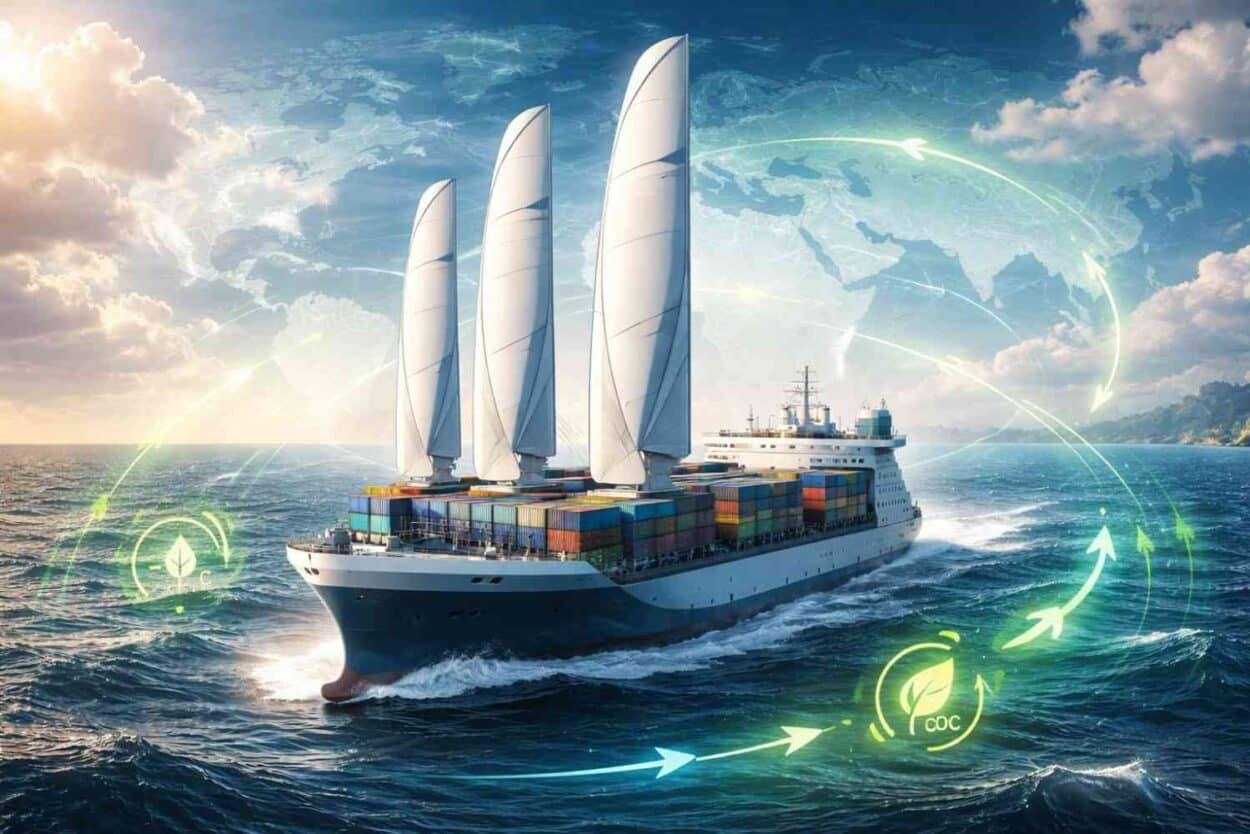
The maritime industry has made a future-focused transformation as wind-powered cargo vessels move from experimental trials to regular commercial service across the Atlantic. With stricter environmental rules and the need to save fuel, 2026 has become a key year for wind-assisted ship propulsion (WASP) technology.
One major company, CMA CGM, has started using a new ship called Neoliner Origin. This ship travels between France, Baltimore, and Halifax.
It uses both fuel and large sails. The sails provide about 60% to 70% of the ship’s power. Because of this, the ship can reduce pollution by up to 90% during its journey.
Using wind power is not just an idea; it is already showing real results. A company called Louis Dreyfus Armateurs added special sails to one of its ships, Ville de Bordeaux.
In just one year, the ship saved over 560 tonnes of fuel. On average, it saved 1.7 tonnes of fuel per day, and sometimes even more. This shows that upgrading existing ships can be very effective.
Another example is Pyxis Ocean, a ship used by Cargill. It uses large wind panels called “WindWings.”
This ship saves about 3 tonnes of fuel every day. These results match what experts expected, giving companies more confidence in this technology.
New environmental rules are one of the main reasons for this shift. In 2026, shipping companies must follow stricter rules under the EU Emissions Trading System (EU ETS).
There is also a possible global carbon tax, which could make fuel more expensive. Because of this, companies are looking for ways to reduce emissions and save costs.
A study by Seas At Risk shows that adding wind systems to ships can reduce energy use by up to 12%. It also helps ships meet environmental ratings and avoid extra costs.
In the near future, a new ship called VELA will be launched. It is designed to run almost completely on wind power.
This ship could reduce emissions by up to 99% compared to air transport, making it one of the cleanest options available.
As NAPA CEO Mikko Kuosa notes, efficiency is now the most important way to reduce emissions. With wind propulsion installations doubling in the last two years, the maritime industry is proving that wind power is a scalable, effective solution for a greener future.