
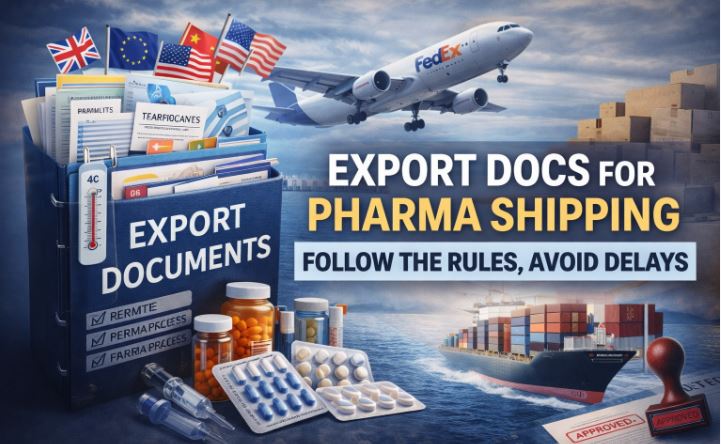
How can exporters safely and efficiently ship pharmaceutical products across the globe?
The answer is to follow thorough export documentation for pharma shipments, which ensures regulatory compliance, product safety, and hassle-free customs clearance.
Even a small mistake in pharma export documentation can lead to costly delays, regulatory fines, or even compromised product safety. Because of this, every certificate, license, and declaration plays a vital role. Instead of being just paperwork, these documents act as critical safeguards. As a result, they help ensure that life-saving medicines reach patients on time and in perfect condition.
Let’s know about the essential documentation for pharma shipments.
Understanding the Complexity of Pharma Export Compliance
Pharmaceutical shipments are classified as high-risk cargo due to their direct impact on human health. Governments and regulatory authorities impose strict controls to ensure that exported medicines are safe, effective, authentic, and traceable throughout the supply chain.
Several factors make pharma export documentation particularly complex:
- Products may be prescription-only, controlled, or temperature-sensitive
- Regulations vary widely by destination country
- Some products are classified as dangerous goods or biological substances
- Documentation must align with manufacturing, quality, and transport standards
Unlike other industries, documentation errors in pharma logistics can have clinical consequences, not just commercial ones. This is why regulators require extensive paperwork to confirm product origin, quality, safety, and handling conditions.

Key Regulatory Bodies Governing Pharma Exports
Pharma export documentation is governed by multiple regulatory authorities at both national and international levels, including:
- National health authorities (e.g., Ministry of Health): Approve products for export and issue pharma-related certificates
- Customs authorities: Imply export and import regulations, duties, and classification rules
- Drug regulatory agencies (e.g., FDA, EMA, or national equivalents): Establish standards for drug safety, manufacturing, and distribution
- International Air Transport Association (IATA) and International Civil Aviation Organization (ICAO): Regulate air transport of pharmaceuticals and dangerous goods
- World Health Organization (WHO): Provides global guidelines for pharmaceutical quality and distribution
Export documentation must satisfy the requirements of all relevant authorities at the same time. Therefore, accuracy and consistency are extremely important to avoid delays, rejections, or compliance issues.
Core Export Documents Required for Pharma Shipments
These documents are needed to ensure compliance with rules, maintain safety, prevent problems, and make shipping easier.
Commercial Invoice
The commercial invoice is the foundation of any international shipment. For pharmaceutical exports, it must include:
Full shipper and consignee details
- Accurate product description (generic name preferred over brand name)
- Harmonized System (HS) code
- Quantity, unit value, and total value
- Batch or lot numbers (where applicable)
- Country of origin
Errors in HS codes or vague product descriptions are among the most common causes of customs delays.
Packing List
The packing list provides detailed information on how the shipment is packed and is used by customs officials and logistics providers to verify contents.
Key elements include:
- Number of packages
- Weight and dimensions
- Packaging type (cartons, pallets, insulated containers)
- Product placement within each package
For temperature-controlled pharma shipments, the packing list should also indicate cold chain packaging used.
Air Waybill (AWB)
The air waybill is the transport document issued by the carrier. It serves as:
- A receipt of goods
- A contract of carriage
- A tracking reference
It must accurately reflect the shipment’s contents, handling requirements, and shipper/consignee information. Any discrepancy between the AWB and other documents can lead to inspections or delays.
Certificate of Origin
This document certifies the country where the pharmaceutical product was manufactured. It may be required to:
- Determine applicable duties or taxes
- Comply with trade agreements
- Satisfy importing country regulations
Certificates of origin are typically issued by chambers of commerce or authorized government bodies.
Export License or Permit
Certain pharmaceutical products, such as controlled drugs, psychotropic substances, or experimental medicines, require an export license.
This document confirms that the exporter is authorized to ship the product and that the export complies with national drug control laws.
Pharma-Specific Regulatory Documents
These papers ensure that pharmaceutical products meet all rules and can be shipped smoothly.
Certificate of Pharmaceutical Product (CPP)
A CPP confirms that a pharmaceutical product is authorized for sale in the exporting country and manufactured according to regulatory standards.
It is often required by importing countries for:
- Finished pharmaceutical products
- Market authorization or registration
The certificate is issued by the national drug regulatory authority.
Good Manufacturing Practice (GMP) Certificate
The GMP certificate demonstrates that the manufacturing facility complies with recognized quality standards.
Importing authorities rely on GMP certification to ensure product safety, consistency, and quality.
Free Sale Certificate
This document confirms that the product is freely sold and legally marketed in the exporting country.
While similar to a CPP, it is often used for non-prescription medicines, medical devices, or supplements.
Batch Release Certificate
For biologics, vaccines, and certain injectables, a batch release certificate confirms that a specific production batch has passed quality testing and is approved for distribution.
This document supports traceability and recall readiness.

Documentation for Temperature-Controlled Shipments
Many pharmaceutical products require strict temperature control throughout transit. Additional documentation may include:
- Temperature stability statements
- Cold chain validation reports
- Data logger declarations
- Temperature monitoring records
Dangerous Goods and Special Cargo Documentation
Some pharma shipment services fall under dangerous goods regulations, including:
- UN3373: Biological Substance, Category B
- UN3245: Genetically Modified Microorganisms
Required documents may include:
- Shipper’s Declaration for Dangerous Goods
- Specialized packaging certification
- Proper labeling and marking
- Proof of dangerous goods training
When you fail to comply, it can cause shipment rejection or regulatory penalties.
Customs Clearance Documentation
Customs clearance requires close coordination between exporter, carrier, and broker. Common documents include:
- Export customs declaration
- Import permits from destination country
- Product registration certificates (if required)
Accurate HS code classification is critical, as misclassification can lead to fines or shipment seizure.
Digital Documentation and Traceability Systems
The pharmaceutical industry increasingly relies on digital documentation to improve accuracy, speed, and traceability. Examples include:
- Electronic air waybills (eAWB)
- Digital commercial invoices
- Electronic customs filing systems
Digital records also support audits, recalls, and regulatory inspections by maintaining a clear chain of custody.
To Conclude
Export documentation for pharma shipments is not only required for administrative clearance. Additionally, it plays a critical role in patient safety and ensures proper handling throughout transportation.
By working with professionals such as Lading Logistics, exporters can efficiently manage the shipment process, with support for documentation, customs clearance, and shipping.
FAQs
What is export documentation for pharma shipping?
Export documentation includes all the papers and certificates needed to legally and safely ship pharmaceutical products internationally.
Why is accurate pharma export documentation important?
Accurate documentation ensures regulatory compliance, prevents shipment delays, avoids fines, and protects patient safety.
Which documents are essential for pharma exports?
Key documents include the commercial invoice, packing list, air waybill (AWB), certificate of origin, export license, and pharma-specific certificates like CPP and GMP.
Do temperature-controlled shipments require special documents?
Yes. Cold chain shipments may need temperature stability statements, data logger reports, and dry ice declarations to comply with regulations.